Max Venton - flight engineer

Max Venton, age 21 came from Melksham, Wiltshire Max was an ex-pupil of Trowbridge Grammar School, he enjoyed the outdoor life and was articled to the town surveyor in Melksham. With thanks to Max's brother Colin for the portrait photograph.

Trowbridge Grammar School
Max's family had a small business selling and servicing cycles and motorcycles in Melksham.
Coincidentally, my mother as a young girl of 14 years old and having just left school, worked in Webbs the Bakers.


As a young man Max kept a diary of his many "adventures" in the countryside around his home town. He was a great observer of nature and had a an avid interest in topography and land use, which undoubtedly linked up with his desire to become a surveyor.
This account relates to "Cuff's Corner just outside Melksham.

He was also a member of the local Air Training Corps (ATC) which had been established on 5 February 1941, with King George VI agreeing to be the Air Commodore-in-Chief, and issuing a Royal Warrant setting out the Corps' aims. A new badge was designed for the ATC and, once approved by the King, was distributed in August 1941. The motto ' Venture Adventure ', devised by Air Commodore Chamier, was adopted by the ATC and incorporated into the badge.

.....my father aged 19 in his ATC uniform in early 1942.
ATC cadets on parade and.....


This extract gives an idea of some of the ATC activities: "ATC in the evening. Tried out Aldis lamp with NCO's and drill." The next day was "Morse with the Aldis lamp and navigation."
An extract from Dad's diary: "Work. Miserable day. Comp lost. Only six planes seen (this was in Dad's work as fire-watcher from the roof of a local factory). Went up the camp in the evening. Had a game of rugger. Went to the NAAFI with Max and Wilf afterwards."


Dad had already written in "Got Prof(iciency) certificate (pilot)" for May 11 1942, but this certificate shows that the previous November he also had the Wireless Op. award.
Other diary entries show that they studied maths, navigation, P.T., rifle shooting, aircraft recognition, morse code, gas defence etc.
Max's Service Record takes over:
The front side gives personal details, some parts have been redacted but nothing of significance. Important dates shown are 31/12/41 when he entered the RAFVR, awarded pilot's flying badge (his "wings") 29/6/43 and death presumed on 4/3/45. He had served in the RAF for 3 years and 64 days.
Further dates in his service are shown on the reverse side in an often cryptic form, so decoding is by the side in date order with further explanations and comments below.

1. Recruitment Centre at Weston Super Mare.
2. Accepted and put on Reserve list
3. Called to Aircrew Reception Centre, London
4. Sent to S. Rhodesia
5. Arrived at Initial Training Wing Hillside Camp
6. Elementary Flying Training School
7. Service Flying Training School
8. South Africa on way home
9. 7 Personnel Reception Centre, Harrogate
10. 16 EFTS Burnaston Derby
11. Back to Harrogate 7 PRC
12. No.24 Aircrew Holding Unit Whitley Bay
13. Back to Harrogate 7 PRC
14. RAF Oakley, Bicester
15. Back to Harrogate 7 PRC
16. 22 EFTS Cambridge
17. Back to 7 PRC Harrogate
18. No.4 School of Technical Training St Athan
19. 51 Base Swinderby
20. RAF Balderton then back to Swinderby (75 Base)
21. No.5 Lancaster Finishing School
22. 467 Squadron, Waddington

1 and 2: Weston Super Mare is a typically English seaside town situated on the Bristol Channel, some 60 miles from his home town of Melksham. Whilst at the Recruitment Centre he would have undergone some tests in English and Maths, had a medical and been interviewed to determine his suitability as aircrew. He was accepted immediately and put on the reserve list.

3. After an impatient wait of just over six months, Max received his call up letter and was instructed to report to the Aircrew Reception Centre at Regents Park, London, along with hundreds of other young recruits.


My father's diary for that period records:
On Sunday 12th July 1942, I left Melksham and travelled to London, spent the night at my relatives and reported next morning, 13th July, at Lords (Cricket Ground). That day I filled in various forms, was put into No. 8 Flight and collected a uniform and kit. The Flight was then marched, (it seemed miles) to St. James’ Close (this was a modern empty block of flats overlooking Regents Park) which was to be our home for the next few weeks. It all seemed very strange, marching around in a body and still wearing civilian clothing, sharing a room with five other chaps (sleeping on the floor on beds made from three square “Biscuits” and two blankets and washing/shaving in cold water without the benefit of mirrors) and eating at long tables (in the Zoo restaurant, being given two plates on which porridge, and bacon and beans were slapped), hundreds at one sitting.
The next fortnight was one of medical examinations (including an “FFI”, free from infection which involved dropping one’s trousers and underpants while the MO looked for any overt signs of venereal or skin disease), inoculations, vaccinations, blood tests, fitting of uniforms and plenty of drill.
We were allowed out in the evenings. I soon paled up with some chaps and we would go to cinemas in various parts of London.
4. 24th August: Sent to Southern Rhodesia to begin pilot training. Again my father's voice:
Volunteers for overseas were then asked for and I was one of the ‘lucky’ ones. Exactly two weeks after entering we were told that we were going on leave. Two days of filling in forms and packing and then we were away on seven days.
They were rather uneventful days, having been away from home for two weeks they were not appreciated and I was longing to be back again. When I got back I had to have some inoculations, draw flying kit and several large scale inspections. After a week of this we embarked on lorries which took us to the station and in the afternoon we found ourselves at West Kirby. Here we drew our tropical kit and had a rest cure for a week, spending the larger part of the day in West Kirby, Hoylake or Meols.
Whilst at West Kirby Max sent this postcard to his friend Dick back in Melksham:

The reference to the canoe is one that Dick and Max built together so that they could go exploring on the R. Avon, they had many adventures together hiking, cycling and canoeing.
Dad's diary again:
On Sunday 23rd August we left West Kirby. We boarded the train at about 23.00 hours and there we heard our last air-raid siren. When we awoke we were in Avonmouth and we went from the train to the “Highland Brigade”, (our home for the next six weeks). Everything was rather crowded and not at all comfortable. We wrote our farewell letters and that evening left port and anchored in the Bristol Channel. We stopped there all day and started out in the evening, arriving two days later in the Clyde.
We started out “proper” the next evening and took a last look at the country we love. Then came ten days, the first three of which were very miserable ones, not being able to eat and feeling queer inside. When that had passed I had a fairly enjoyable time. The canteen was fairly well stocked and the weather was lovely.
The next sixteen days we saw nothing but the sea. Each night my pal (Max) and I would buy a mug of beer, some biscuits and cheese and then retire to the aft boat deck to study the stars. I was mess orderly and so spent most of the day guarding the mess tins and keeping a place in the queue.

SS Highland Brigade
Dad's diary shows that their studies started on their journey to their home for the foreseeable future with lectures on morse, aircraft recognition and navigation. And of their own volition, they went out on the deck at night to study the stars ready for astro-navigation. They would have to learn the constellations of the southern hemisphere.

They finally reached the port of Durban in South Africa, then faced the long but fascinating two or three day journey by train to Rhodesia and Hillside Camp, but they were in for a bit of a disappointment as Dad's diary reveals:
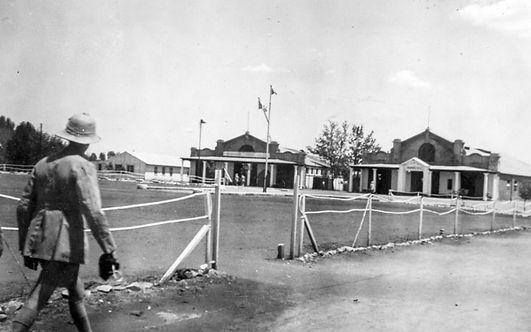
5. On 1st October at about 20.00 hours we arrived in Bulawayo. All the other cadets at the ITW (Initial Training Wing) gave us a most hearty welcome. We were given a very good meal and billets made from gum poles and hessian!
We were all anxious to get through ITW and get onto flying, but we were due for a big disappointment, having to wait in, what was called Receiving Depot for nine weeks before starting the ITW course.
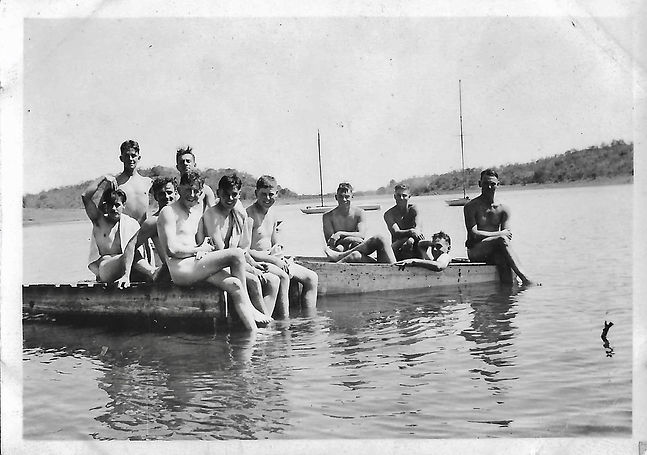
But all these eager young chaps had to be kept occupied in a practical way as well as attending lectures. One such task was called a "Bundu Bash". The bundu is the grass and scrub lands, the bush. These expeditions had a very practical use because all too frequently aerial navigation exercises went awry and a forced landing in the bush miles from anywhere could easily prove to be disastrous. Max's letter to Dick explains more:


.jpeg)
In the bundu on a bash with their destination, Lake Matopos in the distance.
And relaxing "in the buff" once they reached the lake!
More of Max's engaging writing:

.jpeg)
Below, Max and two mates on a dry riverbed, maps in hand ready to navigate further:

During their time at ITW Hillside, there were daily lectures and much studying to do, trainees had to study a syllabus which covered many of the aspects that Max had studied in the ATC such as anti-gas, aircraft recognition, armament, drill and physical training, engines, hygiene and sanitation, law and discipline, administration and organisation, mathematics, meteorology, navigation, principles of flight, signals.


At the end of their time at ITW there were exams to sit before the trainees could progress to the next stage of posting to an EFTS and flying. Here, Fate played a hand for Max was posted to:
6. 27 EFTS Induna, which is near Bulawayo, whereas Dad was sent to 28 EFTS, near Salisbury (Harare). To my knowledge, they never met again.

Further information on Max's training will be found in the "Trade Training" section.